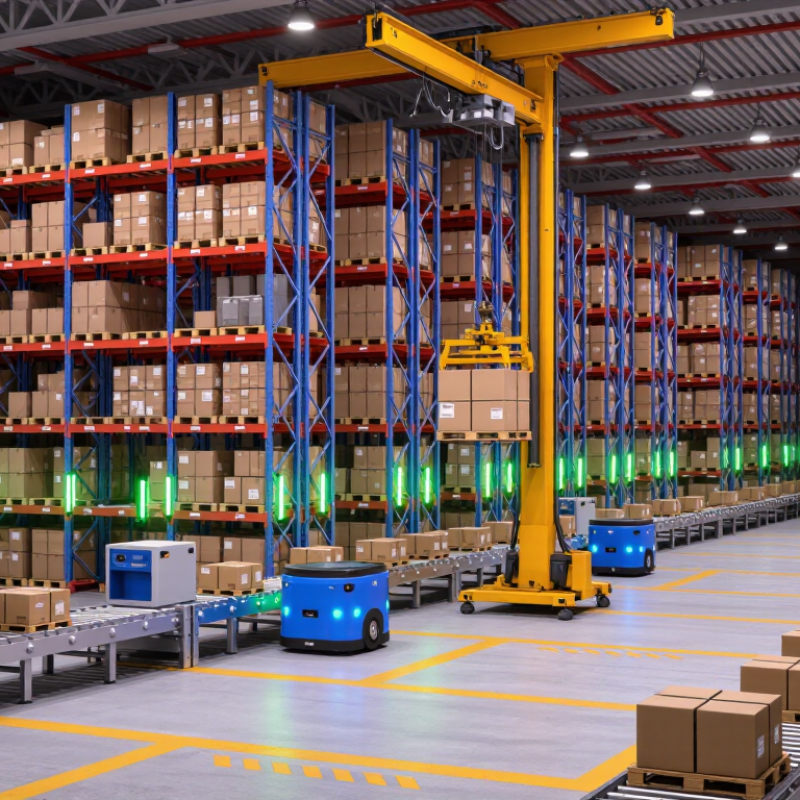
Stacking Systems are engineered solutions that store, organize, and retrieve goods in limited vertical space. They appear in warehouses, distribution centers, parking facilities, and manufacturing plants. Depending on the design, they may use pallet racks, automated storage machines, conveyors, robotic shuttles, or compact shelving.
Their purpose is simple.
Use space better.
A stacking system places products at different heights while preserving controlled access and safe movement. Sensors can identify each load, while software records its location and retrieval history. In an automated warehouse, a crane or shuttle may collect a pallet from a rack several meters high. In a parking structure, platforms can lift vehicles into unused overhead space.
As warehouse automation expert Ralf Pätzold explains, “Automation must create value for the customer, not merely add technology.” This principle matters because a sophisticated system can still fail when product sizes, traffic patterns, or worker routines are misunderstood. The technology is only one part of the solution.
Effective Stacking Systems depend on accurate measurements, balanced loads, clear safety zones, and regular inspections. A poorly planned aisle can slow every retrieval. An incorrect weight rating can create serious operational risks. Even small labeling errors may send workers searching through multiple rack levels.
The strongest designs combine engineering judgment with real operating data. They also leave room for human oversight. That part is sometimes underestimated.
This guide examines how Stacking Systems work, which components support them, and where their advantages may become limitations. It also considers energy use, maintenance demands, installation costs, and the practical mistakes that planning documents often overlook.
What Are Stacking Systems and How Do They Work?
Definition and Core Purpose of Stacking Systems
A stacking system stores products vertically, using floor space more efficiently. It may involve pallet racks, block stacking, shelving, or automated storage equipment. The core purpose is simple: increase storage density while keeping goods stable, identifiable, and reachable. Loads are placed in planned positions, often by forklifts or stacker cranes. Each position needs a defined weight limit, clearance, and access route. A warehouse may look full, yet poor placement can create wasted space and unsafe handling.
Industry data shows why this matters. The International Federation of Robotics reported 541,302 industrial robots were installed worldwide in 2023. This figure does not represent stacking equipment alone. However, it reflects the wider movement toward automated material handling. Modern systems can scan locations, monitor inventory, and place pallets with consistent accuracy. Human supervision still matters. Sensors can fail, labels can be damaged, and unusual loads can confuse automated rules.
Good design also considers floor strength, load balance, aisle width, fire protection, and retrieval frequency. Fast-moving goods usually need lower, easier-to-reach positions. Slow-moving stock can use higher levels. The logic sounds neat. Real warehouses are not. Products change, packaging collapses, and demand forecasts miss the mark. For that reason, regular inspections and layout reviews remain essential. A stacking system is not merely a taller shelf. It is a controlled method for using vertical space without sacrificing safety, access, or operational visibility.
| Stacking System Type | Basic Operating Principle | Primary Purpose | Typical Storage Density | Selectivity | Suitable Inventory Profile |
|---|---|---|---|---|---|
| Block Stacking | Unit loads are placed directly on the floor and stacked vertically without rack structures. | Maximize floor utilization with a simple, low-cost storage method. | High floor density; height is limited by load stability and product strength. | Low | Uniform, durable, and non-fragile goods handled in large batches. |
| Pallet Racking | Pallets are stored in horizontal rack levels, with aisles providing access to individual positions. | Provide direct access to many separate stock-keeping units. | Moderate to high, depending on rack height and aisle width. | High | Diverse products requiring frequent replenishment and retrieval. |
| Drive-In Stacking | Handling equipment enters rack lanes to place loads on support rails, creating deep storage lanes. | Increase pallet density by reducing the number of access aisles. | Very high | Low | Large quantities of the same or similar product. |
| Push-Back Stacking | Pallets are loaded from the front and move backward on inclined rails as additional pallets are stored. | Combine higher density with access to multiple product lanes from one aisle. | High | Medium | Products stored by batch, date, or product category. |
| Pallet Flow Stacking | Pallets move by gravity along inclined roller lanes from the loading side to the picking side. | Support first-in, first-out inventory rotation and efficient order picking. | High | Medium to high | Perishable, date-sensitive, or regularly replenished goods. |
| Mobile Stacking | Storage rows move on floor-mounted rails so that only the required access aisle is opened. | Increase space utilization while retaining access to stored loads. | Very high | High when an aisle is opened | High-value or space-sensitive inventory with moderate access frequency. |
| Automated Stacking | Automated equipment stores and retrieves loads according to digital instructions and inventory records. | Improve storage accuracy, throughput, space usage, and operator safety. | High to very high | High | Standardized loads, controlled workflows, and operations requiring traceability. |
A stacking system stores goods vertically. It uses racks, shelves, platforms, or automated carriers. The goal is simple: save floor space. Goods must remain stable, visible, and reachable.
Workers or lifting equipment place loads into planned positions. Each position has a weight limit, clearance, and access route. Scanners may track locations. Sensors can still fail.
Uprights carry vertical loads. Beams support pallets. Braces improve stability. Anchors resist movement. Decking supports stored items. Guards help protect frames from equipment impacts.
Designers should check load weight, pallet size, aisle width, floor strength, and lifting equipment. They should also consider fire protection and building conditions. Real sites are rarely perfect.
Vertical storage increases storage density. Shorter travel routes may reduce handling time. Fast-moving goods belong in lower, accessible positions. Slow-moving goods can use higher levels.
Keep aisles clear. Follow posted capacity limits. Use visible warning signs and guarded movement zones. Never bypass an interlock. Stop after unusual noise, vibration, or delayed movement.
Inspect it regularly, based on operating hours and site conditions. Check frames, fasteners, rails, brakes, cables, chains, and electrical connections. Record defects and repairs. Checklists help, but judgment still matters.
Overloading, uneven floors, damaged frames, and unstable loads create risks. Ignoring small defects can cause costly failures. Packaging may collapse. Forecasts may also be wrong.
No. Automated equipment can scan positions and place loads accurately. However, damaged labels, failed sensors, and unusual loads can confuse systems. People must review unusual conditions.
Stop and examine the event. Review loading methods, traffic routes, and equipment condition. Update the plan when needed. The system may look safe, yet still have weaknesses.
Stacking Systems are organized structures designed to store items vertically, making better use of available floor space while keeping goods accessible and stable. Their core design typically includes frames, platforms, supports, connectors, and protective features that work together to distribute weight safely. Depending on the setting, these systems may be adjusted to accommodate different item sizes, storage levels, and workflow requirements.
In operation, users place goods onto designated platforms or supports, following weight limits and loading sequences to maintain balance. Common applications include warehouses, workshops, archives, retail storage areas, and other environments where space efficiency is important. Effective Stacking Systems can improve organization, increase storage capacity, and reduce unnecessary movement. Regular inspections, proper load distribution, secure assembly, and timely maintenance are essential for preventing instability and extending the system’s service life. Safety procedures should always be followed, especially when handling heavy items or accessing elevated levels.

 Luyuan Racks